Category: YouTube Niche Guide

In depth guides on the most profitable YouTube niches RPM data,
channel setup, scripting, monetization strategy and growth tactics.

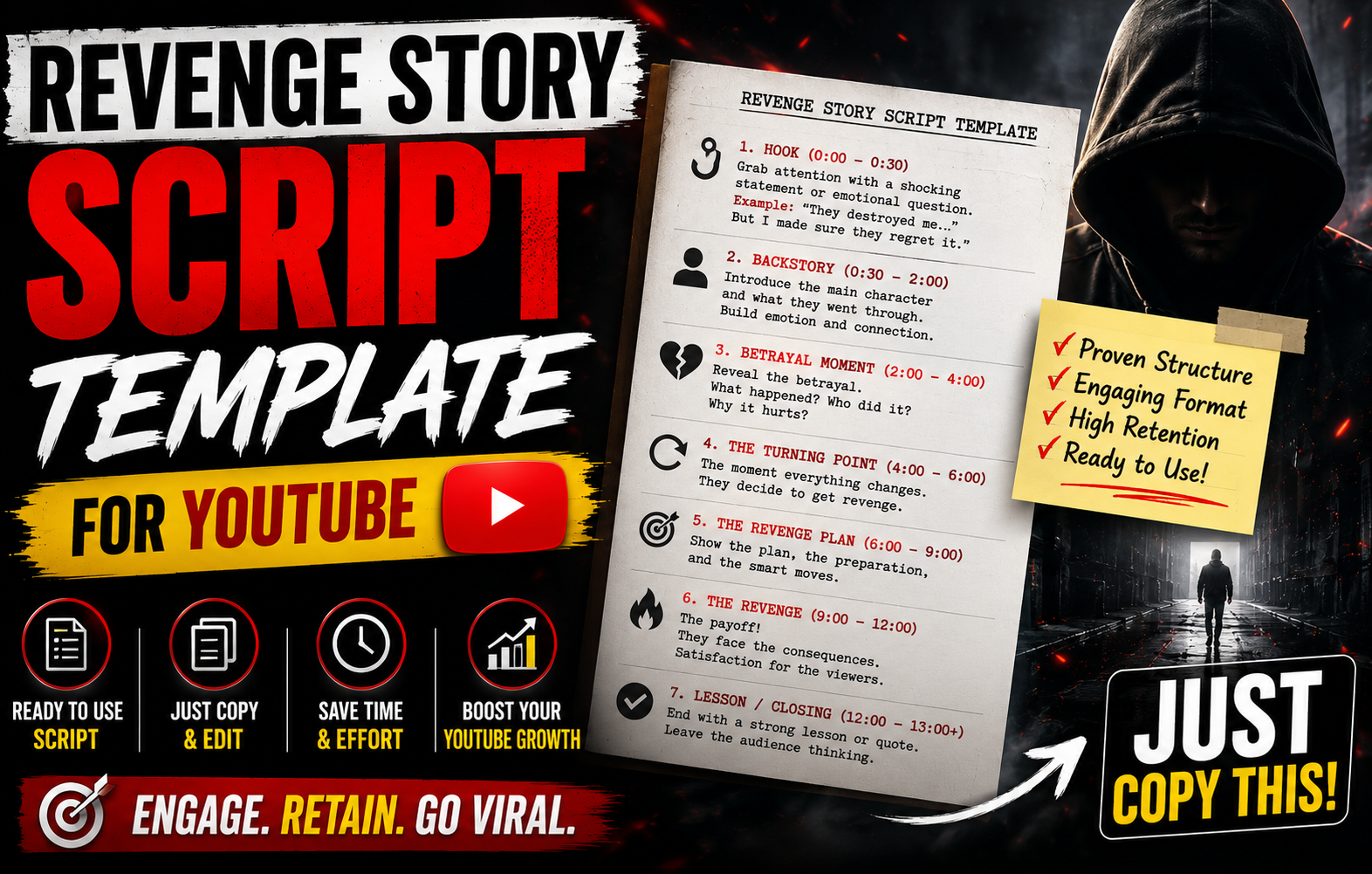
  • Revenge Story Script Template for YouTube: Just Copy This

    Revenge Story Script Template for YouTube: Just Copy This

    Revenge Story Script Template you can copy, fill the placeholders and create your story video using AI tools. This is completely free AI prompt for betrayal and revenge story creation.

    Most betrayal and revenge YouTube channels die in their first 30 days not because the stories are bad, but because the scripts are structured wrong.

    They open with background. They introduce the narrator before the injustice. They pace the betrayal too slowly, rush the revenge, and close with a vague ending that gives viewers no emotional release. The result: 35–40% audience retention, zero recommended traffic, and a channel the algorithm refuses to push.

    The channels generating $12.82 RPM in this niche the highest verified creator take home rate on YouTube right now are not running on better stories. They are running on a better script structure. A specific, tested, emotionally engineered formula that tells the viewer’s brain exactly what emotional reward is coming and when.

    This is that formula. A complete revenge story script template for YouTube that you can copy, fill in, and publish built specifically for the betrayal and revenge narrative niche, with real word for word examples, retention benchmarks for each section, and a full fill in the blank template at the end.

    If you are beginner in betrayal and revenge niche explore our dedicated guide for How to Start a Betrayal and Revenge YouTube Channel in 2026

    Why Structure Matters More Than Story Quality

    YouTube’s algorithm in 2026 primarily rewards watch time and retention rate. A 10 minute video where people watch 8 minutes (80% retention) beats a 20 minute video where people watch 6 minutes (30% retention). Every sentence in your script should serve one purpose: keep viewers watching.

    In the betrayal and revenge niche, this principle is amplified. Your audience is watching because they want a specific emotional experience outrage at the injustice, tension during the build, catharsis in the resolution. Deliver that experience in the right order at the right pace and your retention holds. Deliver it out of order or skip emotional beats and viewers drop off, regardless of how dramatic the story is.

    This is why identical story premises perform completely differently on different channels. A cheating partner story told with a weak structure averages 38% retention. The same emotional premise told with the 5-act structure below averages 72–78% retention. The story is the same. The structure is different.

    For videos between 5 and 15 minutes, a healthy average percentage viewed is 40 to 55 per cent. This is the length where pacing becomes critical. Betrayal and revenge videos that consistently hit 70%+ are outliers and they achieve that because their script structure matches the psychological pattern the audience’s brain is primed for.

    That pattern has five acts. Every one of them has a specific job.

    The 5-Act Revenge Script Formula Explained

    The 5-act revenge formula is derived from the storytelling architecture behind the highest retention betrayal channels in 2026, cross-referenced with the key building blocks of revenge stories including the climax that deals with two possible outcomes: the protagonist’s moment of triumph where they complete their goal and get justice, or their failure that resolves the main conflict.

    Here is the high level structure before we break each act apart:

    ActNameTimestamp RangeRetention GoalPrimary Job
    Act 1The Injustice Hook0:00–1:30Hold 80%+ viewers past 90 secOpen in the injustice. Create outrage AND anticipation.
    Act 2The Build1:30–6:00Hold 70%+ through backgroundLayer the betrayal details. Build emotional investment.
    Act 3The Revelation6:00–10:00Hold 75%+ at the pivotFull exposure of the betrayal. Shift from victim to planner.
    Act 4The Revenge Execution10:00–20:00Hold 65%+ through longest sectionMethodical, specific, satisfying revenge delivery.
    Act 5The Resolution20:00–EndHold 80%+ for the final 60 secDeliver the catharsis. Convert the viewer to a subscriber.

    The two critical retention points to watch in YouTube Studio:

    The 90 second mark and the 10-minute mark. If your retention curve shows a significant drop at either point, Act 1 or Act 3 is not doing its job. Most channels struggling with retention have a weak Act 3 the revelation comes too slowly or without sufficient emotional weight, and viewers who have been patient through the build decide the payoff is not coming and leave.

    Act 1 — The Injustice Hook: The 15 Second Survival Window

    The primary goal of a powerful YouTube hook is to earn the viewer’s investment for the next 30 seconds, thereby maximizing the video’s overall viewer retention rate. The hook must instantly communicate the outcome, benefit, or central conflict of the video, ensuring the viewer understands why they should spend their valuable time watching.

    In betrayal and revenge content, this means one thing: open in the middle of the injustice, not before it.

    The most common Act 1 mistake is chronological opening starting at “let me tell you about my marriage” before reaching the betrayal. Every second you spend on background before the injustice is a second you are bleeding viewers. 20–40% of viewers drop off in the first 10 seconds. They clicked your video based on title and thumbnail, but if the opening doesn’t immediately confirm they’ll get what they came for, they’re gone.

    The 3-component hook formula for betrayal content

    Component 1 — The injustice statement (1–2 sentences): State the betrayal directly. Specific, concrete, immediate.

    Correct: “My husband of eleven years had a completely separate family. I found out on the morning of our anniversary when a seven-year-old girl called him ‘Daddy’ in a grocery store parking lot.”

    Wrong: “Today I want to tell you about something that happened to me a few years ago in my marriage. It was a really difficult time.”

    The difference: the correct version drops the viewer directly into a specific, visual moment of betrayal. The wrong version tells the viewer nothing emotional and gives them a reason to leave.

    Component 2 — The stakes establishment (1 sentence): Tell the viewer what was at risk or what was lost.

    “I had given up my career, my friendships, and eleven years of my life to someone who was living a lie the entire time.”

    Component 3 — The control signal (1–2 sentences): This is the most important component. It signals to the viewer that the narrator has power that this is not a victimhood story but a justice story. This single signal is what separates content that gets 35% retention from content that gets 75%.

    “I didn’t cry in that parking lot. I drove home, made dinner, and spent the next four weeks building a case. This is what happened to him.”

    The control signal tells the viewer: the narrator is not helpless. A satisfying ending is coming. Stay and watch it.

    Act 1 hook formulas — copy and adapt

    Formula 1 — The Discovery Opener: “[Describe the exact moment of discovery in one sentence]. I had [time period] to process it. Then I started planning.”

    Formula 2 — The Timeline Reveal: “For [time period], I smiled, cooked dinner, and acted like everything was fine. What [name/relationship] didn’t know was that I had known the truth for [time period] and I had been using every single day.”

    Formula 3 — The Outcome First: “By the end of this story, [antagonist] had lost [specific losses]. I want to tell you exactly how that happened and why I don’t feel guilty about any of it.”

    Formula 4 — The Witness Line: “I was not supposed to be in that [location] at that time. But I was. And what I saw changed the next [time period] of my life completely.”

    Act 2 — The Build: Emotional Investment Architecture

    Act 2 is where most script writers lose viewers they should not lose. The background information that makes the betrayal meaningful is necessary but it has to be delivered in a specific way to prevent the retention curve from dropping.

    The job of Act 2 is to make the viewer feel what the narrator felt before they knew the truth. This is called emotional retroframing presenting the narrator’s past happiness or trust in a way that the viewer knows is wrong, creating dramatic irony that keeps them watching to see the moment everything falls apart.

    The emotional retroframing technique

    Instead of stating background facts neutrally, frame them as evidence of the betrayal the viewer already knows is coming.

    Neutral background (causes drop-off): “We met in college in 2013. We got married in 2016. We had a good life together and I trusted him completely.”

    Emotional retroframing (holds retention): “I still have the photo from our 2018 vacation. We’re both laughing at something I can’t remember what. What I know now is that he was already seeing her by then. That photo was taken during the same month she says she first knew she was pregnant with his child. I look at that photo differently now.”

    The retroframing version takes the same information and charges it with meaning the viewer already knows, creating the feeling of painful dramatic irony that betrayal content is specifically engineered to produce.

    Act 2 structure — layer by layer

    Layer 1: The relationship history (concrete and specific) Establish the length and depth of trust. Use one or two specific details not a general summary. A specific detail (the exact number of years, a specific shared experience, a particular thing they built together) creates emotional investment that “we were close” never does.

    Layer 2: The first signs that were ignored These are the moments the narrator dismissed at the time that they now understand. The darkest moment is the emotional core of a storytelling script. Write it first, in as much detail and specificity as you can. What exactly happened? What were the specific stakes? What did you think or feel? The ignored signs work because they make the viewer feel complicit in the betrayal they were watching the clues too and also let them pass.

    Layer 3: The escalation evidence Before the full revelation, there should be a moment where the narrator got close to the truth but did not quite reach it. This creates a near-miss that raises tension before Act 3.

    Act 3 — The Revelation: The Hinge That Locks Viewers In

    Act 3 is the structural hinge of the entire script. It is where the story shifts from a betrayal narrative to a revenge narrative. Done correctly, it creates what screenwriters call the “point of no return” a moment where the viewer’s emotional investment locks in and dropping off becomes psychologically uncomfortable.

    There are two stages to Act 3:

    Stage A: The Full Discovery

    The moment the complete truth is revealed. This should be the most specific, concrete, visually described moment in the entire script. Vague revelations (“I found out everything”) generate no emotional response. Specific revelations generate visceral reactions.

    “The folder had 47 pages in it. Bank statements. Hotel receipts. Screenshots of messages. A lease agreement for an apartment I had never seen signed jointly. Two names. His and hers. The lease started three months after our wedding.”

    Every detail adds weight. The number 47 is more impactful than “many.” The lease starting three months after the wedding is more devastating than “it had been going on a long time.”

    Stage B: The Control Decision

    This is the single most important moment in your entire script. The moment the narrator decides not to react immediately but to plan. Get this line right and your retention locks in. Get it wrong and your audience starts drifting in Act 4.

    High retention control decision lines:

    • “I put the folder back exactly where I found it. I drove to work. I did not say a single word.”
    • “I closed the laptop, made tea, and sat at the kitchen table for forty minutes deciding what to do. By the time I finished that tea, I had decided three things.”
    • “The anger was there. But there was something under it that felt colder and much more useful. I decided to use that instead.”

    What all of these have in common: They show the narrator transitioning from emotional reaction to strategic thinking. The viewer registers this shift as power and power is what they came to see.

    The Act 3 bridge line

    End Act 3 with a single sentence that bridges into Act 4 and re-establishes the promise from your opening hook:

    “I had [time period] before [event]. That was enough.”

    Act 4 — The Revenge Execution: The Longest and Most Important Act

    Act 4 is the act viewers came for. It is also the act most scripts rush, underwrite, or handle incorrectly. The three most common Act 4 mistakes:

    Mistake 1: Making the narrator angry instead of strategic Screaming matches, emotional confrontations, and dramatic tearful scenes feel like satisfying revenge but actually reduce audience retention because they position the narrator as reactive rather than in control. The highest retention revenge executions are methodical, calm, and multi-step. Viewers stay for controlled power, not emotional outbursts.

    Mistake 2: Rushing the execution Act 4 should be the longest act in your script. Viewers who invested through Acts 1–3 have earned the detailed execution. Give them every step. What was prepared. What was communicated to whom. What happened when. In what order. The satisfaction comes from the methodical, layered delivery not from a single confrontation.

    Mistake 3: Making the revenge disproportionate Revenge that far exceeds the original betrayal makes the narrator unsympathetic. The viewer’s satisfaction depends on justice feeling proportional. Losing a job for cheating: proportional. Losing their entire life, relationships, housing, and career over a workplace slight: disproportionate and unsatisfying.

    The Act 4 structure — step by step

    Step 1: The preparation phase

    Detail what the narrator did before any confrontation. This is the planning section and it is crucial for the strategic positioning of the narrator.

    “Week one: I contacted a [relevant professional lawyer, financial advisor, HR]. Week two: I moved [asset/resource] that they didn’t know about. Week three: I made contact with [third party who needed to know].”

    Step 2: The evidence collection (if applicable)

    The most satisfying revenge scripts include a moment where the narrator assembled undeniable evidence before confrontation. This is both a plot element and a retention device each piece of evidence revealed is a mini payoff that holds viewers through the longer Act 4.

    Step 3: The strategic communication sequence

    Who found out, and in what order? The most dramatically effective revenge scripts tell third parties before telling the antagonist. The viewer knows something the antagonist does not another layer of dramatic irony that holds attention.

    Step 4: The confrontation (if included)

    Not all revenge scripts include a direct confrontation and those that do should position it as the narrator’s controlled choice rather than an emotional reaction. If included, the confrontation should be brief, controlled, and devastating in its calmness.

    Strong confrontation script line: “I had one sentence prepared. I had rehearsed it twice. I sat across from [name], waited for silence, and said it. Then I left without waiting for a response.”

    Step 5: The cascade of consequences

    The most satisfying Act 4s end with multiple consequences arriving for the antagonist professional, social, financial, relational each one landing separately and escalating. This escalation structure is what drives the retention spike that high performing revenge channels consistently show in YouTube Studio at the 15–18 minute mark.

    Act 5 — The Resolution: The Emotional Payoff That Builds Subscribers

    Act 5 has three jobs, and all three must be present for the closing to convert viewers into subscribers.

    Job 1: The karma confirmation

    State clearly and specifically what the antagonist’s situation is now. This is what the viewer has been watching to see. Deliver it directly, without hedging.

    “As of [timeframe], he no longer works in [industry]. The second family he chose over ours has been through two rounds of counseling. He sent me a message six months ago. I did not open it.”

    “Things eventually worked out and he got what he deserved.”

    Job 2: The narrator’s current state

    Brief one to two sentences. Where is the narrator now? This provides the audience with the validation that leaving was right, moving forward was right, and the revenge was the end of a chapter rather than a permanent obsession.

    “I moved to [city/state] eighteen months ago. I took the position I had turned down when we got married. I go to sleep without checking my phone. That took longer to earn than anything else in this story.”

    Job 3: The subscriber conversion line

    The final 15–30 seconds of your script should be written specifically to convert the emotional connection of the resolution into a subscribe action. The most effective subscribe conversion lines for this niche connect the viewer’s personal experience to the channel’s ongoing content.

    High conversion closing formulas:

    Formula 1 — The shared experience close: “If any part of this felt familiar if you have been sitting across from someone and smiling while carrying something they don’t know you know I want you to hit subscribe. I share a new story every [day/week]. Some of them are even longer than this one.”

    Formula 2 — The justice community close: “I read every comment. I know a lot of you have been through something similar. Tell me in the comments what you would have done differently. And subscribe because the next story is going to make this one look mild.”

    Formula 3 — The curiosity close: “I have not told you everything. There is one more part of this story I left out deliberately. I am going to share it in a follow up video for subscribers only. Subscribe with the bell notification on. It will be up [day].”

    Pattern Interrupt Techniques for Betrayal Scripts

    Human attention spans on video are measured in seconds, not minutes. You need to recapture attention constantly.

    Pattern interrupts are scripted moments that reset viewer attention before they drift. In voiceover narrated betrayal content, pattern interrupts cannot rely on visual cuts (since you are using stock footage or AI visuals) they have to be scripted into the narration itself.

    Verbal pattern interrupt techniques for betrayal scripts

    Technique 1: The pause question A direct rhetorical question dropped into the narration mid act. “I need to stop here for a second. Because what I found next changes everything I just told you.” This works by creating a micro-curiosity gap that refreshes viewer engagement at the exact moment attention is starting to drift.

    Technique 2: The number revelation Introducing a specific number that the viewer did not expect. “I counted later. He had sent her 1,847 messages in the six months I thought we were fine. I know the exact number because I printed all of them.” Specific numbers create visceral impact and snap attention back.

    Technique 3: The time jump “Fast forward six weeks. Everything I had set up was in motion. Three things happened in the same 24-hour period that I did not plan but I was ready for.” Time jumps signal that something is about to happen and buy 2–3 minutes of renewed attention.

    Technique 4: The quiet line A sudden shift to very short, very simple sentences after a longer paragraph. “She knew. She had always known. And she kept coming to our house anyway.” The rhythm shift creates the sensation of a revelation landing even when it is a piece of information already introduced.

    Technique 5: The object detail Ground the abstract in a specific physical object. “He had left his laptop open on the kitchen table. I have thought about that detail many times since. Of all the mornings to leave it open. Of all the windows to leave active.”

    9. Word Count and Timing Guide Per Act

    Most creators speak at 130–150 words per minute in narration. Use this table to hit the target timestamp for each act:

    ActTarget DurationWord Count (130 wpm)Word Count (150 wpm)Retention Target
    Act 1 — Hook1 min 30 sec~195 words~225 words80%+
    Act 2 — Build4 min 30 sec~585 words~675 words70%+
    Act 3 — Revelation4 min~520 words~600 words75%+
    Act 4 — Execution10 min~1,300 words~1,500 words65%+
    Act 5 — Resolution2 min~260 words~300 words80%+
    Total~22 min~2,860 words~3,300 words

    A 22 minute video at these word counts gives you 4–6 mid roll ad slots, which is where the $12.82 RPM comes from. Videos under 12 minutes in this niche miss the mid-roll revenue window and earn 40–60% less per 1,000 views. Do not cut your script short to keep production time down.

    The Complete Fill In The Blank Revenge Story Script Template To Copy

    Copy this entire template. Replace everything in [brackets] with your story’s specific details. Do not change the structural transitions between acts they are the retention mechanics.

    ACT 1 — THE INJUSTICE HOOK

    [OPEN DIRECTLY IN THE MOMENT OF BETRAYAL – no introduction, no background]

    “[Describe the exact moment of discovery in one specific, visual sentence. Include a concrete detail a name, a location, a number, a physical object.]

    [State what was at risk or what was lost as a result of this betrayal – one sentence.]

    [THE CONTROL SIGNAL – The narrator decides not to react immediately. Two sentences maximum. This line must show calm decision making, not emotion.]

    This is what happened next.”

    ACT 2 — THE BUILD

    “[His/Her/Their] name is [name or pseudonym]. We had been [relationship type] for [exact time period].

    [ONE specific detail that establishes the depth of trust – a shared experience, a sacrifice made, a specific moment of genuine connection.]

    [TWO OR THREE IGNORED SIGNS – Present each as something the narrator dismissed at the time and now understands differently. Frame each using retroactive knowledge: ‘What I know now is…’ or ‘I understand now why…’]

    [THE NEAR-MISS – A moment where the narrator almost found out the truth but didn’t. This raises tension before Act 3.]

    I thought I knew exactly what my life was. I was [time period] wrong.”

    ACT 3 — THE REVELATION

    “[THE SPECIFIC DISCOVERY – Describe the physical moment of finding out the full truth. Use concrete details: documents, messages, dates, numbers, locations. The more specific, the more emotionally impactful.]

    [LAYER THE DETAILS – Add two to three additional pieces of evidence that expand the scope of the betrayal beyond the initial discovery.]

    [THE EMOTIONAL RESPONSE Two to three sentences on the internal reaction. Keep it controlled and specific. Avoid generic phrases like ‘I was devastated.’]

    [THE CONTROL DECISION – The narrator decides to plan rather than react immediately. This is the hinge of the entire script. One to two sentences. Calm. Decisive. Cold.]

    I had [time period] before [triggering event the confrontation, the meeting, the filing, the announcement]. That was more than enough.”

    ACT 4 — THE REVENGE EXECUTION

    “[PREPARATION – What did the narrator do before any confrontation? List specific preparatory actions in sequence. Use time markers: ‘First,’ ‘By [day/week],’ ‘Before [event]’]

    [EVIDENCE COLLECTION – What was assembled and how? Be specific about what was documented, copied, saved, or shared.]

    [STRATEGIC COMMUNICATION – Who found out before the antagonist did? In what order? Why that order?]

    [PATTERN INTERRUPT #1 – Use one of the verbal techniques: pause question, number revelation, time jump, quiet line, or object detail. Place here at approximately the 13–14 minute mark.]

    [THE CONFRONTATION if included – Brief, controlled, the narrator’s choice. One prepared line delivered calmly.]

    [THE CASCADE – List the consequences that followed in sequence. Each consequence should be specific and proportional to the betrayal.]

    [PATTERN INTERRUPT #2 – Place at approximately the 17–18 minute mark. A second refresh of attention before the final act.]

    [Name/antagonist] had options throughout all of this. [He/She/They] made a choice at every stage. So did I.”

    ACT 5 — THE RESOLUTION

    “[THE KARMA CONFIRMATION – State specifically and concretely what the antagonist’s situation is now. Two to three sentences. No hedging.]

    [THE NARRATOR’S CURRENT STATE – Brief, one to two sentences. Where are you now? What does normal life feel like?]

    [THE UNIVERSAL STATEMENT – One sentence that speaks to anyone who has been betrayed. This line is what viewers share and screenshot.]

    [THE SUBSCRIBE CONVERSION – Use one of the three formulas: shared experience close, justice community close, or curiosity close. 20–30 seconds maximum.]”

    End of template.

    How to Use AI to Generate Revenge story

    AI script tools have become genuinely useful in 2026, especially for generating first drafts and hook variants. The key limitation across all tools is niche-specific accuracy: AI doesn’t know your audience’s specific language, your competitors’ top videos, or the data patterns in your space. The best workflow combines AI generation with human editing.

    Here are the exact AI prompts for use with Claude, ChatGPT, or Gemini that generate structurally correct betrayal/revenge scripts using the 5-act formula:

    AI Prompt For Betrayal Revenge Story Generation

    Prompt 1 – Full script generation

    You are a YouTube scriptwriter specialising in betrayal and revenge 
    narrative content. Write a complete 2,800-word script using the 
    5-act structure below. Open directly in the injustice — no 
    introductory framing. Use specific concrete details throughout. 
    The narrator must demonstrate controlled strategic thinking in 
    Act 3 and Act 4, not emotional reactions.
    
    Story premise: [Paste your story premise here]
    
    Act structure:
    Act 1 (195 words): Open directly in the betrayal moment. Hook, 
    stakes, control signal.
    Act 2 (585 words): Background through emotional retroframing. 
    Three ignored signs. One near-miss.
    Act 3 (520 words): Full revelation with specific details. 
    Control decision pivot line.
    Act 4 (1,300 words): Preparation, evidence, strategic 
    communication, confrontation if any, cascade of consequences. 
    Include two pattern interrupts.
    Act 5 (260 words): Karma confirmation, narrator's current state, 
    universal statement, subscriber conversion close.

    Prompt 2 — Hook only (when you want multiple options)

    Write 5 different opening hooks for a YouTube betrayal and revenge 
    story about [story premise]. Each hook must:
    1. Open directly in the injustice, not before it
    2. Use a specific concrete detail in the first sentence
    3. Include a control signal — the narrator deciding to plan 
       rather than react
    4. Be 150–200 words maximum
    5. End with a bridge line that creates anticipation for what follows

    Prompt 3 — Pattern interrupts

    For this section of a YouTube betrayal script [paste Act 4 draft], 
    add three verbal pattern interrupts that refresh viewer attention 
    without breaking the narrative flow. Use these techniques: one 
    pause question, one number revelation or specific detail, and one 
    quiet line (short simple sentences after longer paragraphs). 
    Insert them at natural pacing transition points.

    Critical reminder: All AI generated scripts require human editing before publishing. Review each draft for generic phrasing, replace vague statements with specific details, and ensure the narrative voice is consistent throughout. YouTube’s inauthentic content policy requires demonstrable original creative contribution AI first drafts that are published unedited are at risk of demonetization.

    Always enable the “Altered or synthetic content” toggle in YouTube Studio before publishing any video narrated with AI voiceover. Check your channel’s current monetization status and estimated earnings anytime with Toolbil’s free YouTube Monetization Checker.

    Script Mistakes That Destroy Retention

    These are the six most common scripting mistakes in betrayal and revenge channels and the fix for each.

    Mistake 1: Chronological opening

    What it looks like: Starting the script at the beginning of the relationship or situation, building toward the betrayal.

    Why it kills retention: 20–40% of viewers drop off in the first 10 seconds. If your hook is “let me tell you about how we met,” those viewers are gone before the betrayal even arrives.

    The fix: Move the moment of discovery to the first sentence. Every relevant background can be delivered in Act 2 as retroframed context.

    Mistake 2: Telling emotions instead of showing specifics

    What it looks like: “I was devastated.” “It was the worst day of my life.” “I couldn’t believe what I was seeing.”

    Why it kills retention: Generic emotional statements create no visceral response in the viewer. Specific details do.

    The fix: Replace every generic emotion statement with a concrete sensory detail. Not “I was devastated” but “I sat in my car in the parking lot for forty minutes before I could drive. I know it was forty minutes because I checked the clock three times.”

    Mistake 3: Making the narrator emotional and reactive in Act 4

    What it looks like: The revenge is a screaming confrontation, a dramatic public scene, or an emotional breakdown.

    Why it kills retention: Viewers watch betrayal content for the satisfaction of controlled justice, not emotional drama. A narrator who loses control in Act 4 makes the viewer feel uncomfortable rather than satisfied.

    The fix: Keep the narrator strategic and calm through Act 4. Emotion belongs in Acts 1 and 3. Acts 4 and 5 belong to controlled, methodical execution.

    Mistake 4: A vague resolution

    What it looks like: “Everything eventually worked out.” “She got what she deserved.” “Things are better now.”

    Why it kills retention: The resolution is the emotional payoff the viewer sat through 20 minutes to receive. A vague payoff feels like a broken promise.

    The fix: Be specific. State exactly what the antagonist’s situation is now professional, social, relational, financial. One specific consequence is more satisfying than three vague ones.

    Mistake 5: No control signal in Act 3

    What it looks like: The narrator finds out the full truth and immediately confronts the antagonist.

    Why it kills retention: The control signal is the moment viewers understand this is a justice story, not a victimhood story. Without it, Act 4 loses its narrative momentum.

    The fix: Insert the decision moment. Even one sentence: “I did not say a word. I needed time to think.” This pause creates the structural shift that holds Act 4 retention.

    Mistake 6: Copying Reddit posts verbatim

    What it looks like: Pasting a Reddit story directly into an AI voiceover tool and publishing it.

    Why it kills the channel: YouTube’s inauthentic content policy, updated July 2025, explicitly includes content that narrates external sources without adding original creative contribution. Channels building on verbatim Reddit narration are being demonetized in 2026 with increasing frequency.

    The fix: Use Reddit stories as source material only. Rewrite completely in your own narrative voice, add structural elements the original post lacks, and ensure the published script could not have been produced without your specific creative choices. Use Toolbil’s YouTube Video Data Extractor to analyse the tags, structure, and metadata of top-performing channels in this niche and understand what original elements their scripts contain.

    Frequently Asked Question

    What is the best revenge story script template for YouTube? The most effective template for betrayal and revenge YouTube channels is the 5-act structure: Injustice Hook, The Build, The Revelation, The Revenge Execution, and The Resolution. The complete fill-in-the-blank version of this template is in Section 10 above. It is specifically designed for 20–25 minute videos that earn multiple mid-roll ad placements and the $12.82 RPM this niche produces.

    How long should a revenge story script be for YouTube? Target 2,800–3,300 words for a 20–22 minute video at 130–150 words per minute narration speed. This length enables 4–6 mid-roll ad placements, which drives the premium RPM this niche earns. Scripts under 1,500 words (under 12 minutes) miss the mid-roll revenue window and earn significantly less per 1,000 views.

    What is the most important part of a revenge story script? The control signal at the end of Act 3 — the moment the narrator decides to plan rather than react immediately. This single structural element is what separates betrayal content with 35% retention from content with 70%+ retention. Without it, Act 4 loses narrative momentum and viewers drift.

    Can I use AI to write my betrayal and revenge YouTube script? Yes, with mandatory human editing. AI tools generate structurally competent first drafts quickly, but they default to generic emotional statements instead of specific concrete details the exact element that drives retention. Use the prompts in Section 11 to generate a first draft, then edit every generic phrase into a specific detail. All AI-narrated content must have the YouTube “Altered or synthetic content” disclosure enabled before publishing.

    How do I avoid demonetization on a betrayal and revenge channel? Three rules: (1) Never narrate Reddit posts or any external source verbatim rewrite completely in your own voice. (2) Enable the “Altered or synthetic content” toggle for all AI-narrated videos. (3) Ensure every published script demonstrates original creative contribution through specific details, narrative voice, and structural choices that could not have been auto generated without human input.

    What makes betrayal and revenge content hold 70%+ audience retention? The combination of dramatic irony (the viewer knowing the truth before the antagonist does), the control signal (making the narrator strategically powerful rather than a victim), specific concrete details (which create visceral emotional response), and proportional justice (which delivers the satisfaction the viewer came for). Scripts that hit all four elements consistently outperform scripts that hit only one or two.

    Where do I find stories for my betrayal and revenge YouTube channel? Three sources: (1) Reddit — r/AITA, r/ProRevenge, r/relationship_advice, r/MaliciousCompliance — as source material to be completely rewritten. (2) Viewer submissions via a Google Form in your channel description. (3) Original fiction, which has zero copyright concerns and unlimited supply via AI-assisted generation. Check Toolbil’s free YouTube Tag Generator to find the exact search terms your target audience uses when looking for this type of content.

    The Script Is the Product

    In the betrayal and revenge niche, the algorithm does not care about your equipment, your thumbnail quality, or how many videos you post per week if your scripts cannot hold viewers. Retention is everything and retention in this niche is completely structural.

    The 5-act formula above produces 70%+ audience retention when followed correctly. The fill in the blank template in Section 10 is the exact starting point. Every section of that template has a specific retention job. Do not skip sections, do not reorder acts, and do not rush Act 4.

    If you want to see what the top-performing channels in this niche are earning from their scripts, use Toolbil’s free YouTube Monetization Checker to check any channel’s estimated monthly revenue instantly, free, no login needed.
  • 12 Best Betrayal and Revenge Story YouTube Channels in 2026 (ranked by subscribers, storytelling style and RPM)

    12 Best Betrayal and Revenge Story YouTube Channels in 2026 (ranked by subscribers, storytelling style and RPM)

    If you are looking for the best betrayal and revenge story YouTube channels to binge or study before starting your own, this guide
    covers the 12 most important ones in detail with verified
    subscriber counts, monthly earnings estimates, and a breakdown
    of exactly what makes each one work.

    The betrayal and revenge storytelling niche is the fastest growing content category on YouTube right now 21× year over year growth, verified $12.82 RPM the highest YouTube niche , and an audience that watches longer and engages harder than almost any other niche. Channels like Revenge With Jake and Stories of Retaliation use AI narration over stock footage, making it fully automatable.

    We’ve analysed over 50 channels in this niche and selected the 12 that represent the full spectrum from million subscriber giants to fast rising newcomers who cracked the formula in under six months.

    Why the Betrayal and Revenge Niche Is Exploding in 2026

    Faceless storytelling channels represent an unexpected entry in the top performing YouTube niches, with betrayal and revenge narratives achieving 21× year over year growth. This category proves that compelling narratives outperform polished production when executed well.

    Three factors are driving this explosion simultaneously:

    The algorithm change. YouTube’s 2025 algorithm update specifically rewards watch time and audience retention over upload frequency. Betrayal and revenge stories typically 15–30 minutes with emotional arcs that hold viewers to completion are algorithmically ideal content. This is the highest RPM niche because it combines long watch times with advertiser friendly drama content.

    The AI production shift. Top earning niches on YouTube in 2026 include revenge and drama storytelling at $12–$13 RPM. AI voiceover tools have made it possible for a single creator to produce a 20-minute video in under an hour. Production costs are minimal compared to output quality, enabling daily uploads that compound subscriber growth.

    The audience demand gap. The niche rewards storytelling skills over on-camera presence. Universal themes of betrayal, justice, and redemption resonate across demographics and languages. The primary audience women aged 25–45 navigating complex relationships is one of YouTube’s most engaged demographics, and they’re not being served by enough quality content yet.

    How We Ranked These Channels

    Every channel on this list was evaluated across five criteria:

    • Subscriber count and total views — verified from public data (May 2026)
    • Estimated monthly earnings — based on FindAChannel gravity scores and SpeakRJ analytics data
    • Content format — faceless AI narration, voice actor, on-camera presenter, or mixed
    • Growth trajectory — is the channel growing, plateauing, or declining in 2026?
    • Niche specificity — how dedicated is the channel to betrayal/revenge vs. general storytelling?

    This is not a subjective “best channels” list. Every metric is sourced from public analytics data verified as of May 2026. Estimated earnings are based on publicly available data and represent approximations actual revenue varies based on CPM, engagement, and monetization tier.

    The Complete Comparison Table

    #ChannelSubscribersTotal ViewsEst. Monthly EarningsFormatNiche Focus
    1Charlotte Dobre2.52M1.7B$8,000–$15,000+On camera presenterBroad storytelling/reactions
    2Cake Lovers1.3M304M~$2,817Faceless AI narrationReddit stories + drama
    3UE Stories328K253.9M~$2,520Faceless narrationGeneral inspiring stories
    4r/mr redder193K127.6M~$1,225Voice actor (human)Reddit: r/ProRevenge, r/AITA
    5Slash Start129K174.3M~$1,527Faceless AI narrationKaren/revenge daily uploads
    6Ripe112K100.7M~$1,234Voice actor (human)Reddit storytelling with commentary
    7Karma Stories138K59.1M~$442Human presenter (Rob)Reddit karma/revenge stories
    8Revenge GlowGrowingN/AEmergingFaceless AI narrationFictional betrayal womenfocused
    9The Revenge Stories ChannelGrowingN/AEmergingFaceless AI narrationBetrayal/justice/karma
    10AR Times66.2K15.4M~$112Faceless narrationRelationship betrayal + revenge
    11Revenge Stories (@revenge.stories)GrowingN/AEmergingFaceless AI narrationMarriage/family betrayal + AITA
    12Hellfreezer69.2K30M~$132Human voice (UK)Narration + weekly news round up

    Note: Estimated monthly earnings are approximations based on publicly available analytics tools and industry CPM benchmarks. Check any channel’s exact estimated earnings and monetization status instantly using Toolbil’s free YouTube Monetization Checker.

    Top 12 Channels Detailed Breakdown

    🥇 1. Charlotte Dobre — The Category Leader

    Subscribers: 2.52M | Total Views: 1.7B | Format: On camera presenter Channel: @charlottedobre | Started: 2014 (storytelling pivot ~2020)

    Charlotte Dobre has 2,520,000 subscribers on YouTube with an average of 26,718 likes per video and 1.7 billion total channel views.

    Charlotte Dobre is the closest thing this niche has to a mainstream star. Originally a general lifestyle creator, her pivot to Reddit story reactions and betrayal/revenge commentary is the defining case study in how an existing creator can retool for this niche and achieve explosive growth.

    What she does right: Charlotte presents stories with genuine on camera emotional reactions laughing, gasping, going quiet at the right moments which creates a parasocial connection that faceless channels can’t replicate. Her videos run 15–25 minutes with tight editing and strong pacing. She also operates a dedicated second channel, Charlotte Dobre TV, specifically for reader-submitted confession and revenge stories.

    Format breakdown: Main channel covers Reddit reactions and relationship drama. The TV channel is dedicated betrayal/revenge story narration with Charlotte’s face. This dual channel strategy maximises YouTube’s recommendation system viewers who subscribe to one channel are served the other.

    What new creators can learn: You don’t need to be faceless to win in this niche. An on camera personality creates brand loyalty that faceless channels struggle to build. The tradeoff is production time Charlotte’s videos are polished and require camera setup, editing, and on camera performance. Faceless channels scale faster; Charlotte’s approach builds deeper per-subscriber loyalty.

    Monthly earnings estimate: $8,000–$15,000+ from AdSense alone, based on 1.7B total views and consistent upload frequency. Charlotte’s actual revenue is likely significantly higher including sponsorships, merchandise, and her dedicated second channel.

    🥈 2. Cake Lovers — The Faceless Giant

    Subscribers: 1.3M | Total Views: 304M | Est. Monthly Earnings: ~$2,817 Channel: Cake Lovers (US) | Started: Active US-based channel

    Cake Lovers has 1.3M subscribers and 304M total views with an estimated $2,817 monthly earnings.

    Cake Lovers is the most studied success story in the faceless betrayal/revenge space. At 1.3 million subscribers with daily uploads and completely faceless AI narration over stock footage, it’s the clearest proof that this niche works without a face, a voice actor, or expensive production.

    What they do right: Daily upload consistency is the primary growth engine. At one video per day, the channel accumulates watch hours faster than weekly or bi-weekly channels. The titles follow the proven betrayal template (“She Thought She Won Until…”, “He Didn’t Know I Had Everything Documented”) and thumbnails consistently use high contrast dark backgrounds with shocked expressions.

    Content source: Reddit-inspired stories and originally written fiction, adapted through AI narration. The channel’s disclaimer is careful stories are presented as entertainment without explicit claims of being factual, which protects against both copyright and policy issues.

    Format: Fully automated pipeline — AI-written script or Reddit-adapted script → AI voiceover → stock footage assembly → thumbnail → upload. Estimated production time per video with an established workflow: 25–45 minutes.

    What new creators can learn: Daily uploads at this volume are only possible with a systemised workflow. The channel doesn’t optimise individual video quality it optimises upload volume and consistency. This is a volume driven growth strategy, not a quality driven one. Both work; your choice depends on how much time you can invest per video.

    🥉 3. UE Stories — The Inspiration Hybrid

    Subscribers: 328K | Total Views: 253.9M | Est. Monthly Earnings: ~$2,520 Channel: UE Stories (US)

    UE Stories has 328K subscribers and 253.9M total views with an estimated $2,520 monthly earnings.

    UE Stories occupies a unique position in this niche straddling the line between betrayal/revenge narratives and inspirational storytelling. The channel describes itself as covering “the most entertaining, surprising, and inspiring stories online,” which gives it algorithmic flexibility: the same viewer who watches betrayal content also watches comeback/triumph content.

    What they do right: High total views relative to subscriber count (253.9M views from 328K subscribers) indicates strong algorithmic recommendation outside the channel’s subscriber base. Videos are being recommended to non subscribers at a high rate a sign of exceptional retention and engagement metrics.

    Format: Faceless narration over curated footage and imagery. The visual production quality is notably higher than many competitors custom motion graphics and cinematic B-roll rather than generic stock footage.

    What new creators can learn: The inspiration hybrid format is more algorithmically versatile than pure revenge content. Adding an element of triumph, comeback, and self worth to betrayal stories widens the audience beyond the core revenge demographic and increases recommendation reach.

    4. r/mr redder — The Human Voice Standard

    Subscribers: 193K | Total Views: 127.6M | Est. Monthly Earnings: ~$1,225 Channel: @MrRedderYT | Started: February 2019

    r/mr redder narrates Reddit stories across r/entitledparents, r/prorevenge, r/maliciouscompliance, and r/AITA with a voice actor performing both mr redder and Karen characters.

    r/mr redder is the gold standard for human voice actor storytelling in this niche. Unlike AI narration channels, mr redder performs multiple characters including the antagonist “Karen” which creates a dramatically richer listening experience.

    What they do right: Character performance is the differentiator. When the betrayer has a distinct voice and personality, the emotional investment in the protagonist’s revenge deepens significantly. The character-based format generates extremely high comment rates viewers discuss the characters as if they’re real, which signals strong algorithmic engagement to YouTube.

    Content format: Daily uploads from r/prorevenge, r/maliciouscompliance, and r/AITA. Longer Saturday compilations of the week’s best stories. The channel uses music under a Creative Commons license and background footage from Pexels under the Pexels license.

    What new creators can learn: A distinctive voice performance creates brand identity that AI narration cannot replicate. Viewers who love mr redder are loyal specifically to the character delivery. However, this format does not scale to daily uploads without significant time investment it’s a quality over volume approach.

    5. Slash Start — The Karen/Revenge Daily Machine

    Subscribers: 129K | Total Views: 174.3M | Est. Monthly Earnings: ~$1,527 Channel: Slash Start (US) | Started: August 2017

    Slash Start has 129,000 subscribers with 4,483 videos uploaded so far and 174.3M overall channel views.

    4,483 videos. That number tells you everything about Slash Start’s strategy. This is the most prolific channel in the revenge/Karen storytelling niche daily uploads, consistent format, long running operation since 2017. The channel positions itself as “your daily dose of Karen” which means the content is specifically revenge stories involving entitled behaviour, confrontations, and justice served.

    What they do right: Sheer volume creates an enormous searchable library. New viewers who find one video discover hundreds of similar ones. The internal recommendation loop from this library keeps viewers on the channel longer than any single video could.

    Growth note: Slash Start YouTube total subscribers dropped by -7,000 from January 2024 to March 2026. This plateau/slight decline suggests the Karen specific angle is facing saturation. For new creators, this is a data signal: the pure “Karen” framing is becoming crowded. The broader betrayal/revenge angle with relationship drama and family betrayal is the growth direction.

    What new creators can learn: Volume works but it requires a format so streamlined that daily production is genuinely sustainable. Slash Start’s modest per video view counts are compensated by the total library size. If you cannot sustain daily output, a lower frequency but higher quality approach will outperform this strategy long term.

    6. Ripe — The Commentary Voice Actor

    Subscribers: 112K | Total Views: 100.7M | Est. Monthly Earnings: ~$1,234 Channel: Ripe (US) | Started: February 2019

    Ripe has 112K subscribers and 100.7M total views with an estimated $1,234 monthly earnings. The channel is run by a voice actor who reads and does commentaries on stories, brings characters to life with a variety of funny and interesting voices, and builds an active community through dialogue with viewers.

    Ripe sits at the intersection of betrayal/revenge storytelling and reaction commentary. Stories are narrated with character voices but the creator also adds their own commentary opinions on the characters, verdicts on who was wrong, reactions to the most shocking moments. This commentary layer transforms passive watching into active discussion.

    What they do right: The “verdict delivery” format where the narrator states their opinion at the end of the story (“And that’s why this person was absolutely right to do what they did”) drives comment engagement dramatically. Viewers agree, disagree, and debate in comments, creating community signals that boost algorithmic distribution.

    What new creators can learn: Adding commentary and verdicts to narrated stories increases engagement metrics disproportionately. The slight production overhead of recording your own opinions is worth it for the comment rate improvement comments are one of the strongest engagement signals in YouTube’s 2026 algorithm.

    7. Karma Stories — The Human Host Podcast Format

    Subscribers: 138K | Total Views: 59.1M | Est. Monthly Earnings: ~$442 Channel: @KarmaStoriesPodcast | Started: March 2017 | Based in: Canada

    Karma Stories has 138K subscribers, 59.1M total views, and an estimated $442 monthly earnings. The channel is run by Rob, who delivers daily entertaining Reddit stories with original commentary from favourite subreddits.

    Karma Stories represents the podcast style approach to this niche Rob delivers stories with personal commentary in a conversational format that feels more like a podcast than a traditional YouTube video. The “karma” framing is specifically designed to emphasise justice and consequence rather than revenge as motivation, which makes the content feel morally cleaner and more shareable.

    What they do right: The Canada base is interesting Rob’s relatively neutral accent makes the channel accessible to UK, Australian, and US audiences equally, broadening the potential recommendation reach beyond US-centric channels.

    Earnings note: The $442 monthly estimate appears low relative to 59.1M total views. This suggests either a significant non US audience composition (lower CPM markets) or that the channel is not monetising all available revenue streams. At 138K subscribers in this niche, the channel should be earning $800–$1,500/month from AdSense alone with full US audience composition.

    What new creators can learn: The “karma” framing is an underused angle. Positioning stories as karma delivery rather than revenge makes content more palatable to audiences who feel uncomfortable with pure revenge framing and it widens the shareable demographic.

    8. Revenge Glow — The Fastest Rising New Channel

    Format: Faceless AI narration | Content: Fictional betrayal — women focused Channel: @RevengeGlow

    Revenge Glow shares fictional, story driven narratives inspired by common life situations. Stories focus on women wives, daughters, and individuals facing family betrayal, broken relationships, and toxic dynamics. These are fictional re-enactments created for storytelling and entertainment using narrative techniques and illustrative visuals to explore emotional turning points, personal growth, and justice served.

    Revenge Glow is the most strategically smart newer channel in this niche for one specific reason: fully fictional, fully disclosed. By explicitly stating all stories are fictional and using “Reddit-style” framing rather than claiming stories are real, the channel eliminates every legal and policy risk that affects Reddit-sourcing channels — copyright, privacy, defamation while maintaining the same emotional narrative format.

    What they do right: The women focused positioning (“our stories focus on women wives, daughters, and individuals”) targets the core high engagement demographic directly and explicitly. This specificity makes the channel more algorithmically matchable to the audience that converts best in this niche.

    The disclaimer strategy: All stories, characters, and situations on the channel are fictional. Any resemblance to real persons or events is coincidental. This is the cleanest compliance approach in the niche it satisfies YouTube’s inauthentic content policy requirements while maintaining narrative authenticity.

    What new creators can learn: Fictional storytelling with proper disclosure is the safest long term strategy in this niche. It eliminates copyright risk, eliminates defamation risk, enables AI generation without attribution concerns, and produces content that YouTube’s policy reviewers have no grounds to question.

    9. The Revenge Stories Channel —Justice Focused Storytelling

    Format: Faceless AI narration | Started: April 2026 Channel: UC4b1uhAD9Kv7N1-HfUB-1eg

    The Revenge Stories Channel shares gripping revenge stories, betrayal stories, life lessons, and emotional storytelling. From shocking betrayals to inspiring comebacks, every story reveals how people turned pain into power.

    The Revenge Stories Channel launched in April 2026 making it one of the newest entries on this list and represents the current generation of channels entering this niche. The “pain into power” positioning is the most emotionally sophisticated framing in the newer channel tier: it reframes revenge content as transformation content, which has broader appeal and better advertiser alignment.

    What they do right: Weekly upload cadence rather than daily a quality over volume choice that prioritises longer, more detailed stories over high upload frequency. This strategy targets viewers who have been burned by thin daily upload content and are specifically seeking longer, more satisfying narratives.

    What new creators can learn: April 2026 channel launch with clean professional branding and a clear niche position demonstrates that this niche is still genuinely open for new entrants. The 21× growth rate means the audience is expanding faster than creators can serve it even channels starting in mid-2026 can still reach meaningful size by year end.

    10. AR Times — The Relationship Specialist

    Subscribers: 66.2K | Total Views: 15.4M | Est. Monthly Earnings: ~$112 Channel: AR Times (US) | Started: January 2016

    AR Times delves into the intriguing world of relationship dynamics and human emotions through captivating Reddit stories. From tales of betrayal and cheating to stories of revenge and regret, the channel explores the complexities of human relationships.

    AR Times is notable for its narrow focus exclusively relationship betrayal (cheating, infidelity, romantic deception) rather than the broader family/workplace/friendship betrayal that most channels cover. This specificity makes it the most directly algorithmically matched channel for viewers searching specifically for relationship betrayal content.

    What they do right: The tight niche focus means AR Times likely appears in recommendations for a highly specific set of viewers who are the most engaged audience in this entire space. Quality over quantity: 689 videos in 10 years is a deliberately slow build.

    Earnings note: At $112/month with 66.2K subscribers, AR Times significantly undermonetises relative to its niche. This channel is either not fully monetised or has a heavily non-US audience composition. A CPM optimisation strategy (targeting US search terms, publishing during US peak hours) could dramatically increase earnings without any change to content.

    What new creators can learn: A narrow relationship betrayal focus is a valid niche strategy but it requires a US audience targeting approach to monetise the premium CPM that this specific topic category commands.

    11. Revenge Stories (@revenge.stories) — The Daily Drama Feed

    Format: Faceless AI narration | Content: Marriage/family betrayal + AITA Channel: @revenge.stories

    The channel brings thrilling stories about protagonists betrayed by husbands, harassed by in-laws, and facing relationship problems that ultimately resolve with satisfying revenge. New stories are posted every day.

    Revenge Stories (@revenge.stories) is the pureplay daily-upload revenge channel — no commentary, no personality, just story after story at high frequency. It represents the automation-first approach to the niche: maximum upload volume, consistent format, fast production cycle.

    What they do right: The Reddit-native framing (#aita #reddit #redditstories in every description) directly targets the search terms that drive the most discovery traffic for this niche. The channel acts as a content hub for AITA and relationship advice story consumers who want drama without commentary.

    What new creators can learn: Pure AITA/Reddit story channels without commentary face the greatest risk from YouTube’s inauthentic content policy. To sustain a channel in this format long term, original narrative rewriting (not verbatim Reddit narration) and consistent creative contribution are non negotiable. The channels that get demonetised in this niche are almost uniformly the ones that skip the rewriting step.

    12. Hellfreezer — The UK Narrator

    Subscribers: 69.2K | Total Views: 30M | Est. Monthly Earnings: ~$132 Channel: Hellfreezer (UK) | Started: May 2007

    Hellfreezer has 69.2K subscribers and 30M total views, narrating stories old and new with a weekly news round up. Designed for listening while working, feeling bored or to lull you to sleep.

    Hellfreezer is the most veteran channel on this list started in May 2007, it predates the revenge niche’s current explosion by over a decade. The channel’s “working and sleeping” positioning makes it primarily an audio first experience, which is a different content strategy from the visual-heavy newer channels.

    What they do right: 3.1K videos over 17 years creates an enormous archive. The weekly news round up format adds a topical recurring element that drives habitual subscription behaviour viewers return weekly for new content.

    What new creators can learn: Longevity and consistency over years builds a library that generates passive views long after individual videos are published. Hellfreezer’s 30M total views on 3.1K videos means each video earns views over a long tail not just in the first 48 hours.

    What the Best Channels Have in Common

    After analysing all 12 channels, five patterns appear in every high performing channel regardless of format, size, or age:

    Pattern 1: The justice framing — not pure revenge

    Every top-performing channel frames stories as justice being served, not as revenge being taken. The language difference is subtle but critical for both audience psychology and advertiser safety. “She got what she deserved” is justice framing. “I destroyed her life” is revenge framing. The former is more algorithmically and advertiser-safe; the latter attracts the wrong engagement signals.

    Pattern 2: Emotional specificity in titles

    The titles that generate highest CTR across all 12 channels share one characteristic: a specific, concrete detail rather than a vague promise. “He Thought I Didn’t Know for Three Years” outperforms “My Husband’s Betrayal Story” because it contains a time specific detail that creates curiosity. Every channel in the top 6 uses this formula consistently.

    Pattern 3: Clear production consistency

    Viewers subscribe to betrayal channels for reliable emotional experiences, not surprises in format. Every top channel maintains consistent thumbnail style, consistent narration tone, and consistent video length within a narrow range. Consistency trains the algorithm to recommend the channel to the same audience repeatedly.

    Pattern 4: Comment section engagement

    The highest-earning channels have active comment sections where viewers discuss the stories as if the characters are real. This engagement level signals deep emotional investment to YouTube’s algorithm, which increases recommendation reach. Channels that invite verdict-sharing (“What would you have done?”) have measurably higher comment rates.

    Pattern 5: Proper content disclosure

    Every sustainable channel on this list uses proper content framing either explicit fictional disclaimers (Revenge Glow, The Revenge Stories Channel) or clear Reddit-source attribution (mr redder, Karma Stories). Channels that omit these disclosures face growing demonetisation risk under YouTube’s 2026 inauthentic content policy.

    What New Creators Can Learn from These Channels

    If you are building a betrayal and revenge channel in 2026, these are the four most actionable takeaways from the top 12:

    Lesson 1: Choose fictional over Reddit sourced from the start

    Revenge Glow’s fully fictional approach is the most future-proof strategy. It eliminates copyright risk, eliminates defamation exposure, makes AI generation completely clean, and produces content that YouTube has no policy grounds to question. For new channels starting in mid-2026, the fictional storytelling path is lower-risk and equally high-RPM.

    Lesson 2: Narrow your focus immediately

    The fastest-growing newer channels all have a tighter focus than the broader established channels. “Family betrayal — women-focused” (Revenge Glow) outgrows “all Reddit stories” (Slash Start, Cake Lovers) in algorithmic specificity. The algorithm can match a focused channel to a specific audience more efficiently than a general one.

    Lesson 3: Pick quality or volume not the middle

    Charlotte Dobre and r/mr redder are quality-focused (2–4 videos per week, strong production). Cake Lovers and Slash Start are volume focused (daily). The channels in the middle 3–4 weekly videos with medium production consistently underperform both extremes. Commit to one strategy from the start.

    Lesson 4: Check what’s working before you start

    Before building your channel, research what the top channels in this niche are earning and what their most-viewed videos have in common. Use Toolbil’s free YouTube Monetization Checker to check any channel’s estimated monthly earnings, CPM, and monetization status instantly. Use Toolbil’s free YouTube Video Data Extractor to see the tags, titles, and metadata structure of top-performing videos in this niche.

    And when you’re ready to understand what your growing channel should charge for sponsorships, use Toolbil’s free YouTube Sponsorship Calculator to price your channel correctly before your first brand approach.

    Frequently Asked Questions

    What are the best betrayal and revenge story YouTube channels?

    The best betrayal and revenge story YouTube channels in 2026 include Charlotte Dobre (2.52M subscribers), Cake Lovers (1.3M subscribers), UE Stories (328K), r/mr redder (193K), Karma Stories (138K), and Slash Start (129K). Newer channels including Revenge Glow and The Revenge Stories Channel are among the fastest-rising entries. Each channel covers the betrayal and revenge niche with different formats on camera, voice actor, or faceless AI narration.

    How much do betrayal and revenge YouTube channels make?

    Betrayal and revenge narratives currently show the highest RPM at $12.82 per 1,000 views. At 100,000 monthly views, that equals approximately $1,282/month from AdSense alone. Established channels like Cake Lovers earn an estimated $2,817/month and UE Stories approximately $2,520/month. Charlotte Dobre, with 1.7B total views, earns significantly more including sponsorships and merchandise. Use Toolbil’s free YouTube Monetization Checker to check any specific channel’s earnings estimate.

    Is it too late to start a betrayal and revenge YouTube channel?

    No. The 200K niche size with only low competition means new creators can still rank. Growth is explosive at 21x, driven by YouTube’s algorithm favouring high retention storytelling formats. Channels that started as recently as April 2026 are already growing. The audience demand is expanding faster than creator supply in this niche the early mover window is still open.

    What format works best for betrayal and revenge channels?

    Three formats work: on-camera presenter (Charlotte Dobre), human voice actor (r/mr redder, Ripe), and faceless AI narration (Cake Lovers, Revenge Glow). For new creators, faceless AI narration is the most scalable and lowest production cost entry point. Human voice performance drives deeper engagement per video but limits output volume.

    Do betrayal and revenge YouTube channels use real stories or fiction?

    Both. Channels like r/mr redder and Karma Stories source from Reddit (r/AITA, r/ProRevenge) and adapt stories with human narration. Channels like Revenge Glow use fully fictional stories with proper disclaimers. The fictional approach is increasingly preferred in 2026 due to YouTube’s tightened inauthentic content policy, which creates risk for channels that narrate external sources verbatim.

    What is the best betrayal and revenge YouTube channel for new creators to study?

    Revenge Glow for format and compliance strategy it shows the cleanest 2026-compatible approach. Cake Lovers for volume and scale it shows what a daily upload faceless channel looks like at 1.3M subscribers. r/mr redder for quality and voice performance it shows how human narration builds loyalty that AI channels cannot easily replicate.

    How do I check a YouTube channel’s monetization and earnings?

    Use Toolbil’s free YouTube Monetization Checker. Enter any channel’s name, @handle, or URL to see estimated monetization status, monthly earnings, CPM by country, subscriber count, and total views — free, instant, no login required.

    The Bottom Line

    The betrayal and revenge storytelling niche is producing real, sustainable income for channels of every size from single creators with 10,000 subscribers earning $300–$600/month to faceless channels at 1M+ subscribers generating $15,000+/month. The fastest growing content categories on YouTube are expanding at 15–21× rates, and betrayal and revenge narratives sit at the top of that list.

    The channels on this list all found different paths through the same niche: on-camera personality, voice actor performance, fictional AI narration, Reddit curation. None of them are doing the same thing the same way. That diversity means there is still room for a channel with a distinct voice and a consistent format to grow significantly in the second half of 2026.

    Before you start, check what the channels you want to compete with are earning. Use Toolbil’s free YouTube Monetization Checker to pull any channel’s estimated earnings in 30 seconds so you know exactly what you’re building toward.

  • How to Start a Betrayal and Revenge YouTube Channel in 2026 (Complete Guide)

    How to Start a Betrayal and Revenge YouTube Channel in 2026 (Complete Guide)

    There is a YouTube niche that earns $12.82 RPM the highest verified creator take home rate on the platform right now. It has grown 21x year over year. It requires no camera, no face, no expensive equipment, and no credentials. And almost nobody has idea about how to start betrayal and revenge YouTube channel.

    Yes, I’m talking about the emerging YouTube niche betrayal and revenge narratives and i’m sure at the end of this article you will get detailed information that is enough to start your YouTube channel in this niche.

    While finance creators fight for rankings against million subscriber giants and gaming creators earn $1.50–$5.50 RPM on the same views, creators in the betrayal and revenge storytelling space are quietly generating more per view revenue than personal finance with a fraction of the competition.

    This guide is the only dedicated, step by step walkthrough for starting a betrayal and revenge YouTube channel that exists. If you follow it, you will understand exactly why this niche pays what it pays, how to source unlimited story content legally, what the proven 5 act script structure looks like, which AI tools to use, how to design thumbnails that get double digit CTR, and how to hit monetization faster than most channels in any niche.

    Why the Betrayal and Revenge Niche Pays highest RPM (verified $12.82 RPM )

    Most creators who hear “$12.82 RPM” assume it must be a finance or legal channel. It is not. It is storytelling. And the reason it pays so much comes down to three intersecting factors that most creators never look at.

    Factor 1: Watch time is exceptional

    Long form betrayal and revenge videos typically 12 to 35 minutes hold viewers through the entire narrative arc because of the emotional investment structure. A viewer who is 14 minutes into a story about a cheating spouse getting exposed is not clicking away. YouTube’s algorithm rewards extended watch sessions with higher value ad placements in mid roll slots. More mid rolls per video × higher watch through rate = significantly more ad revenue per view than shorter content.

    Factor 2: The advertiser demographic is premium

    The primary audience for betrayal and revenge content is women aged 25–45. This demographic is one of the highest converting on YouTube for relationship counseling apps, therapy platforms, legal services, self help courses, and premium subscription products. When mental health apps, divorce attorneys, and life coaching brands compete for ad placements against your audience, CPMs climb. Your RPM is directly determined by how much advertisers want to reach your specific viewers.

    Factor 3: Supply hasn’t caught up with demand yet

    OutlierKit data shows 21× year over year growth in this niche with “remarkably low competition.” Audience demand is growing faster than new channels can serve it. In most profitable niches finance, tech, make money online you are competing against channels with millions of subscribers and years of authority. In betrayal and revenge, you are competing against channels that started six months ago.

    This combination of high engagement, premium audience demographics, and early mover advantage is why the niche earns more RPM than finance channels while requiring zero financial credentials.

    Is Betrayal and Revenge Niche Right for Beginners? Be Honest

    Before building anything, run this honest assessment. Betrayal and revenge channels are not right for everyone, and starting in the wrong format wastes months.

    You are well suited for this niche if:

    • You enjoy narrative storytelling — reading, writing, consuming dramatic story content
    • You can sustain a consistent emotional tone in writing (suspense, outrage, satisfaction)
    • You are comfortable using AI tools for voiceover and basic editing
    • You want a faceless channel that protects your privacy
    • You can commit to a consistent posting schedule of at least 2–3 videos per week for the first 60 days

    You should reconsider if:

    • You struggle to write coherent, emotionally engaging narrative
    • You want immediate income (like most niches, monetization takes 3–6 months of consistent work)
    • You plan to use other people’s exact Reddit posts verbatim without adaptation (we cover the legal reality of this in Step 2)
    • You want to show your face and build a personal brand this is a faceless niche by design

    The production reality:

    With modern AI tools, one person can realistically produce and publish one 15–20 minute betrayal and revenge video per day. The actual hands on time is approximately 25–45 minutes per video once you have a workflow established. This is what makes the niche scalable and why some channels in this space publish daily without a team.

    Set Up Your Betrayal and Revenge Channel the Right Way

    Channel setup for the betrayal and revenge niche has specific requirements that differ from generic YouTube advice.

    How to set suitable channel name for betrayal and revenge niche

    Your channel name needs to signal the emotional content immediately. The most successful channels in this niche use names that either reference drama or betrayal directly or suggest narrative storytelling with an emotional edge.

    Naming formulas that work:

    • The [emotion] Chronicles — (The Revenge Chronicles, The Betrayal Chronicles)
    • [name] Confessions — (Anonymous Confessions, Dark Confessions)
    • [story type] Untold — (Betrayal Untold, Hidden Truth Untold)
    • Stories of [emotion] — (Stories of Revenge, Stories of Betrayal)
    • The [narrator archetype] — (The Storyteller, The Witness, The Verdict)

    What to avoid: Generic names like “Drama Channel” or “Story Time” these are too broad and don’t signal the specific emotional content that causes algorithm matched viewers to click Subscribe immediately after watching.

    Use Toolbil’s free YouTube Channel Name Generator to explore name variations and check availability before committing.

    Description and about section for betrayal and revenge channel

    Your channel description is indexed by Google and YouTube search. Include these elements:

    1. State clearly what the channel is: “This channel shares dramatic betrayal and revenge stories narrated for maximum emotional impact.”
    2. Who the stories are for: “For anyone who has felt wronged, overlooked, or cheated and believes in karma.”
    3. Upload schedule: “New stories every [day/week] subscribe so you never miss one.”
    4. Keywords to include naturally: “true stories,” “betrayal story,” “revenge story,” “relationship drama,” “AITA,” “karma stories”

    Betrayal and Revenge channel art and branding

    Betrayal and revenge channels use dark, high contrast branding. The colour palette that consistently performs best in this niche: deep red, black, dramatic gold, or dark purple. Avoid pastels, soft blues, or anything that reads as “friendly content.” Your brand visuals should create the immediate emotional expectation of drama.

    Recommended icon approach: A silhouette, a cracked heart, scales of justice, a shadowed face, or symbolic imagery (a chess piece, a snake, a broken mirror). No real faces this is a faceless channel.

    Source Your Stories from Reddit, Original, and Submissions

    This is the step most aspiring revenge channel creators get wrong or skip entirely. Story sourcing is the engine of your entire channel. Run it poorly and you either run out of content within weeks or get your channel flagged for reused content.

    The three legitimate content sources

    Reddit — with proper adaptation

    Reddit is the largest repository of real betrayal and revenge stories on the internet. The subreddits that provide the best content for this niche:

    • r/AITA (r/AmITheAsshole) — 40M+ members, daily stories of interpersonal conflict, betrayal, and justice-seeking
    • r/ProRevenge — dedicated revenge stories with satisfying outcomes
    • r/MaliciousCompliance — stories of working-within-the-rules revenge
    • r/relationship_advice — ongoing betrayal and infidelity stories
    • r/CharlotteDobreRealStories — this specific subreddit was created for YouTube storytelling content

    The critical legal and policy reality: Reddit posts are not public domain. The original poster owns the copyright to their story. However, ideas, facts, and general situations cannot be copyrighted. You cannot paste a Reddit post word for word into a script and narrate it that is copyright infringement and YouTube’s Content ID system will detect it.

    What you CAN do: Use the situation, the emotional arc, and the key facts as inspiration. Rewrite the story completely in your own voice, with your own sentence structures, additional detail, and narrative framing. This transforms the source material into original creative content. Think of it as a journalist covering a news story the facts are real but the writing is yours.

    The best practice, used by the highest earning channels in this niche: ask for permission in the Reddit comments (“Would you be OK with me turning this into a YouTube story?”). Most people say yes and appreciate the acknowledgment. Many even submit their own stories directly after seeing your videos.

    Original fiction

    Some of the fastest growing betrayal channels in 2026 use entirely original fictional stories. This eliminates all copyright concerns and enables AI tools to generate unique storylines at scale. Fictional betrayal stories are completely permitted on YouTube, require no disclosure beyond the standard AI content toggle if AI-generated, and have unlimited supply.

    Viewer submissions

    Once your channel has a few hundred subscribers, open a submissions inbox (a simple Google Form linked in your channel description). Ask viewers to submit their own betrayal and revenge stories for narration. This builds community, provides an endless stream of authentic original content, and viewers who submitted a story almost always share the video when it publishes driving organic growth.

    Write Your Script Using the 5 Act Revenge Formula

    This is the step most guides don’t include and it is the most important one.

    Generic “storytelling structure” advice will not work for betrayal and revenge content. This niche has a specific emotional arc that viewers are psychologically conditioned to expect and reward with watch time. Deviate from it and your audience retention craters. Follow it and viewers will watch every second.

    The 5 act revenge formula that drives 70%+ audience retention in this niche:

    Act 1. The Injustice Hook (0:00–1:30)

    Open directly in the middle of the injustice. Do not begin with background. Do not introduce the narrator. Start at the moment of betrayal or conflict.

    Structure:

    • The initial injustice stated in 1–2 sentences: “My husband of 12 years had a second family. I found out on our anniversary.”
    • Immediate emotional stakes established: “I didn’t cry. I started planning.”
    • Promise to the viewer: “By the end of this story, you’ll see exactly how I made sure he never saw it coming.”

    Why it works: The viewer needs to know within 15 seconds that this story has a satisfying ending coming. The hook creates both outrage (injustice) and anticipation (revenge). Both emotions are required to lock in the viewer.

    Act 2. The Build (1:30–6:00)

    Establish the full context of the betrayal. Who are the characters, what was the relationship, how long was the deception, and why did it hurt so deeply.

    Key techniques:

    • Use specific, concrete details (“He told me he was working late every Thursday for two years. I later found out those nights were when he saw her”)
    • Build the emotional temperature gradually — introduce each new revelation as a fresh layer of betrayal
    • Use the narrator’s internal monologue to create viewer identification: what was she thinking, what did she tell herself, what signs did she ignore

    Avoid: General statements without specifics. “He was a bad person” tells the viewer nothing. “He left our daughter’s birthday party to take a call from her, and when I looked at his phone later, the call lasted 47 minutes” shows the viewer exactly what kind of person he was.

    Act 3. The Revelation (6:00–10:00)

    The moment the betrayal is fully exposed. This is the emotional climax of the first half of the story and should be written to create a genuine reaction in the viewer.

    Structure:

    • The discovery: how did the narrator find out the full truth?
    • The confrontation or decision: what did they do with this information?
    • The pivot point: this is where the story shifts from victim to architect of revenge

    The most important line in any betrayal revenge video appears in Act 3: The moment the narrator decides not to react immediately but to plan. “I didn’t say a word. I smiled, kissed him on the cheek, and started making arrangements.” This line is the structural hinge between Act 3 and Act 4. Viewers who reach this line almost never click away.

    Act 4. The Revenge Execution (10:00–18:00)

    The methodical, step by step execution of the narrator’s plan. This is the act that drives the longest watch time in the niche. The more specific, calculated, and emotionally satisfying the revenge, the higher the retention.

    Key principles:

    • The revenge must be proportional to the betrayal disproportionate revenge reads as villainous, not satisfying
    • Show the preparation: what did the narrator do before acting? (“I spent three weeks documenting everything before I moved”)
    • Layer the consequences: effective revenge stories have multiple stages, not a single confrontation
    • Use dialogue quoted conversations are the most engaging sections of any script (“I put the folder on the table and said, ‘I think we need to talk about your other life’”)

    What separates good Act 4 from great Act 4: The best revenge execution scenes are not about anger they are about control. The narrator who remains calm, calculated, and one step ahead while the betrayer unravels is far more satisfying to watch than screaming matches.

    Act 5. The Resolution and Karma Confirmation (18:00–End)

    The aftermath. Where did everyone end up? What did the narrator learn? What would they do differently?

    Structure:

    • The immediate aftermath: what happened to the person who betrayed them?
    • The long term outcome: where is the narrator now?
    • The closing statement: something that validates the viewer’s emotional investment (“And that is how I rebuilt everything they tried to take from me”)
    • Optional audience engagement hook: “Has something like this ever happened to you? Tell me in the comments I read every one.”

    The closing 30 seconds are your subscribe driver. The emotional satisfaction of the resolution, combined with a final line that resonates with viewers who have experienced betrayal themselves, is what converts first time viewers to subscribers. Write this closing as carefully as you write the opening hook.

    Choose Your AI Voice

    The voice is the most critical production element in a faceless betrayal channel. The wrong voice kills a perfectly written script. The right voice makes average scripts compelling.

    What the voice needs to do in this niche:

    • Sound human, with natural pacing and emotional variation
    • Carry tension (slow, measured delivery during revelation scenes)
    • Carry controlled anger (slightly increased pace, slightly lower register)
    • Carry triumph (lighter, slightly faster delivery in Act 5)

    A monotone AI voice will destroy your audience retention regardless of how good your script is.

    Recommended AI voice tools for betrayal/revenge content

    ElevenLabs ($22/month Creator tier) — The industry standard for betrayal/revenge channels in 2026. The “Charlotte” and “Rachel” voices have the measured, controlled emotional range that performs best in this niche. The ability to adjust stability and similarity settings lets you dial in exactly the right emotional delivery. If you use one tool, use this one.

    Microsoft Personal Voice (free with Azure) — If you want to clone your own voice but remain faceless, this is the best option. A 1-minute voice clone delivers authenticity that pure AI voices cannot match. Works especially well if you have a natural storytelling cadence.

    Play.ht ($29/month) — Good secondary option. The “Olivia” and “Sophie” voices work well for betrayal content. Slightly more robotic than ElevenLabs at equivalent price points.

    Murf AI ($29/month) — Better for educational content than dramatic storytelling. The voice range is narrower and the emotional dynamics less pronounced. Not ideal for this niche.

    The free option: If you are starting with zero budget, use ElevenLabs’ free tier (10,000 characters/month) to test voice options before committing to a subscription. This is enough for two to three short videos to validate your channel concept.

    Critical 2026 policy reminder: Any AI-generated voice must be disclosed using YouTube Studio’s “Altered or synthetic content” toggle before publishing. This is a YouTube policy requirement not optional. Failure to disclose can result in demonetization. This toggle has no negative effect on your channel’s monetization or ranking it is simply a disclosure label.

    Build Your Video with Stock Footage and AI Visuals

    Betrayal and revenge videos use a specific visual language. Understanding it prevents the most common mistake new channels make using generic stock footage that feels disconnected from the emotional intensity of the narrative.

    The visual formula that works

    Primary visuals (60–70% of the video):

    • Silhouetted figures in dramatic environments shadowed corridors, empty rooms, rain lit windows
    • Close up emotion shots hands, feet, doors closing, phones face down
    • Couple/relationship imagery that transitions from warm to cold as the story progresses
    • Text overlays for key quotes and revelations (use sparingly 3–5 per video maximum)

    Avoid: Generic office stock footage, happy family imagery, overly corporate visuals. Every visual choice should reinforce the emotional tone of the narrative moment.

    Best stock footage sources for this niche

    • Pexels (free) — largest free library, has extensive dramatic/cinematic footage
    • Pixabay (free) — good for atmospheric and emotional B-roll
    • Storyblocks ($15/month) — unlimited downloads, specifically strong in dramatic/cinematic footage that fits storytelling channels

    AI visual generation (for creators who want unique visuals)

    Midjourney and DALL-E 3 (via ChatGPT Plus) both generate dramatic, cinematic imagery that can be used as visual backing for betrayal content. Prompt style: “cinematic still, dramatic lighting, [scene description], emotional, photorealistic, shallow depth of field.” Generated images used as video backgrounds create a more distinctive visual style than stock footage and differentiate your channel visually.

    Editing tools

    CapCut (free) — the most used tool among betrayal/revenge channel creators for its automatic caption generation, subtitle styling, and simplicity. The auto caption feature alone saves 20–30 minutes per video.

    DaVinci Resolve (free) — more advanced, better color grading for the dark aesthetic this niche uses.

    Pictory AI ($19/month) — can assemble stock footage automatically against your audio track, cutting editing time to approximately 10 minutes per video. Good for scaling output.

    Design Thumbnails That Earn 8–15% CTR

    Thumbnails in the betrayal and revenge niche have a specific visual language that consistently achieves 8–15% click through rate. Understanding this is the difference between a video that gets recommended and one that does not.

    The high CTR thumbnail formula for this niche

    Element 1: A shocked or devastated facial expression (even on a silhouette)

    The most clicked thumbnails in betrayal content feature visible emotional expression. If you are creating faceless content, use a silhouette with a hand over the mouth (shock), head in hands (devastation), or a turned away posture (betrayal). Real face or illustrated face the emotional expression is what drives the click.

    Element 2: High contrast dark background

    Black, deep red, or dark charcoal backgrounds make thumbnail elements pop and signal dramatic content immediately. Bright, cheerful backgrounds underperform in this niche by 40–60% CTR.

    Element 3: Short, emotionally loaded text (maximum 5 words)

    The most clicked thumbnail text in betrayal/revenge content:

    • “He Had a Second Family”
    • “She Didn’t Know I Knew”
    • “I Let Him Think He Won”
    • “They All Found Out Together”
    • “She Exposed Him at the Wedding”

    The formula: subject + single action + emotional implication. Keep the font bold, white or red, and readable at thumbnail size (remember most YouTube views are on mobile where thumbnails are small).

    Element 4: Never show the resolution in the thumbnail

    The thumbnail should represent the injustice or the revelation not the revenge execution. The curiosity gap between the betrayal shown in the thumbnail and the revenge that the title implies is what generates the click.

    To research what thumbnail styles are performing best in this niche right now, use Toolbil’s free YouTube Thumbnail Downloader to save and analyse the thumbnails of top performing channels in the betrayal revenge space.

    SEO Your Video: Titles, Descriptions, and Tags

    Title formula

    The highest performing title structures in the betrayal and revenge niche follow these patterns:

    Pattern 1 – The Outcome Tease: “I Discovered My Husband’s Double Life and Waited 3 Months to Respond”

    Pattern 2 – The Setup + Twist: “She Thought I Didn’t Know. I Knew Everything for Two Years.”

    Pattern 3 – The Stakes Statement: “My Best Friend Stole My Identity and My Fiance Here’s What Happened Next”

    Pattern 4 – The Confrontation Promise: “I Exposed My Sister’s Secret at the Family Dinner She Planned”

    What all four have in common: They establish the betrayal, hint at the narrator’s power/control, and create a curiosity gap that requires watching the video to close.

    What to avoid: Question titles (“Did My Boyfriend Cheat on Me?”), vague titles (“My Betrayal Story”), and clickbait that doesn’t deliver (“This Will Shock You”).

    Description structure

    [First 2 sentences — repeat the hook from your video and include the focus keyword]
    
    In this video: [2–3 sentence summary of the story arc]
    
    Chapters:
    0:00 — Introduction
    1:30 — The Betrayal
    6:00 — The Full Truth
    10:00 — How I Responded
    18:00 — What Happened Next
    
    [Relevant links — your other videos in the niche, Toolbil tool links]
    
    Want to check your YouTube channel's monetization status or estimate your earnings?
    Use Toolbil's free YouTube Monetization Checker: [link]
    
    #BetrayalStory #RevengeStory #TrueStories #YouTubeDrama #KarmaStories

    Tags strategy

    Use a mix of broad and specific tags:

    • Broad: “betrayal story,” “revenge story,” “true stories,” “relationship drama,” “karma story”
    • Specific: “reddit aita story,” “cheating husband story,” “workplace revenge story,” “family betrayal story”
    • Long tail: “i discovered my husband was cheating story,” “how i got revenge at work youtube”

    Use Toolbil’s free YouTube Tag Generator to find additional keyword-optimized tags specifically matching your video’s topic and the current search trends in this niche.

    Hit Monetization Faster in This Niche

    The betrayal and revenge niche has a specific monetization advantage most creators overlook: long watch times accumulate 4,000 hours faster than short form content.

    A viewer who watches a 20 minute betrayal video through to the end contributes 20 minutes of eligible watch time toward your 4,000 hour YPP threshold. Compare this to a general vlogging channel where the average video is 8 minutes with 55% retention contributing about 4.4 minutes per view. You need roughly 4.5× fewer viewers to hit the same watch hour milestone.

    The fastest path to 4,000 hours in this niche:

    • Upload 3 videos per week minimum for the first 60 days
    • Every video should be 15–25 minutes long with high retention (the 5-act structure above delivers this)
    • Use YouTube Shorts from your long form content clip the most dramatic 30–60 seconds of each video (usually the Act 3 revelation) and post as a Short with a link to the full story
    • The Short drives subscribers; the long form video drives watch hours. Both move you toward monetization simultaneously.

    At 3 long form videos per week averaging 18 minutes and a 70% average view duration, you need approximately 4,800 views per video to hit 4,000 hours in 90 days. That is achievable in this niche within the first few months for a channel with strong thumbnails and titles.

    Check your progress toward monetization anytime using Toolbil’s free YouTube Monetization Checker. You can also check what established channels in your niche are currently earning to benchmark realistic income targets.

    Revenue Beyond AdSense: The Full Monetization Stack

    The $12.82 RPM figure represents AdSense revenue only. The highest earning betrayal and revenge channels stack multiple income streams on top:

    1. AdSense ($12.82 RPM)

    The foundation. At 500,000 monthly views, this equals approximately $6,410/month from ads alone. At 1 million monthly views, approximately $12,820/month.

    2. Channel Memberships ($5–$15/month per member)

    Offer members exclusive content: extended stories, bonus episodes, behind the scenes of how you source and script stories, or early access to new videos. Betrayal and revenge channels attract deeply loyal audiences (97% audience loyalty rate according to OutlierKit data). Even converting 0.5% of your subscribers to paid members generates meaningful recurring income.

    3. Sponsorships

    Once you hit 10,000 subscribers, relationship-adjacent brands will approach you. Therapy apps (BetterHelp, Headspace), journaling apps, relationship courses, self help book publishers, and legal document services all advertise on this niche. Your viewers are actively navigating difficult relationship situations these advertisers pay well to reach them.

    Calculate your channel’s current sponsorship value using Toolbil’s free YouTube Sponsorship Calculator before your first brand negotiation.

    4. Digital products

    An ebook or course on “how to handle betrayal and move forward” or “how I rebuilt my life after discovering infidelity” aligns perfectly with your audience and requires no ongoing effort once created. The betrayal/revenge audience is highly motivated to consume resources that help them process similar experiences.

    5. Super Thanks and Super Chat (during Live streams)

    Monthly live story sessions where you narrate new stories in real time or react to viewer submitted stories generate Super Chat and Super Thanks revenue. Betrayal channels that run monthly live events report Super Chat revenue of $300–$2,000 per session even at mid tier subscriber counts.

    The One Mistake That Gets Betrayal Channels Demonetized

    This section exists because it is the most important thing to understand about operating a channel in this niche in 2026.

    YouTube renamed its “repetitious content” policy to “inauthentic content” in July 2025.

    Under the old “repetitious content” policy, channels were rejected for posting near identical, mass produced videos. Under the expanded “inauthentic content” policy, channels are now rejected or demonetized for content that:

    • Narrates other sources (Reddit, news articles, other creators’ scripts) verbatim without original contribution
    • Uses identical story templates across videos with only the names and locations changed
    • Produces content where the AI generated script adds no original perspective, narrative voice, or creative element

    This is why Step 3 (the 5-act script structure) is the most important step in this guide. Every video you publish needs to demonstrate original creative contribution your specific narrative voice, your pacing choices, your emotional framing, your dialogue construction.

    The channels that are getting demonetized in 2026 are copy pasting Reddit posts into AI voiceover tools with zero human editing. The channels that are thriving are treating each story as an original creative work that happens to be inspired by real events.

    The test: If your video would be identical to the source material with the names swapped out, you are at risk. If your video is a distinct creative piece that could not have been produced without your specific narrative choices, you are safe.

    Real Earnings Snapshot: What Betrayal Channels Actually Make

    Before starting any channel, you need realistic income expectations. Here is what the data shows for channels in this niche at different sizes:

    Monthly ViewsRPMMonthly AdSenseWith Sponsorships + Members
    50,000$12.82~$640~$900–$1,200
    150,000$12.82~$1,920~$2,800–$3,500
    500,000$12.82~$6,410~$9,000–$12,000
    1,000,000$12.82~$12,820~$18,000–$25,000

    These are US audience estimates. International audiences reduce the RPM to $4–$8 in the same niche. If you follow the SEO strategy in Step 7 – using English language titles and descriptions optimised for US search intent your audience will naturally skew toward US viewers, maintaining the premium RPM.

    Frequently Asked Questions

    How to start a betrayal and revenge YouTube channel for free?

    You can start completely free using Reddit as your story source, ElevenLabs’ free tier (10,000 characters/month) for AI voice, Pexels and Pixabay for stock footage, CapCut for editing, and YouTube itself. The only cost is time. Upgrade to paid tools ($47–$100/month total) once you hit your first monetization milestones.

    How many subscribers do you need to start earning from a betrayal channel?

    YouTube requires 1,000 subscribers and 4,000 watch hours (or 10 million Shorts views in 90 days) for full AdSense monetization. The 500 subscriber Expanded YPP tier unlocks fan funding features (Super Thanks, memberships) earlier. Given the long watch times in this niche, most channels hit 4,000 hours before 1,000 subscribers.

    Is it legal to use Reddit stories on YouTube?

    Reddit posts are copyrighted by their original authors. Copying them verbatim is infringement. However, facts, situations, and story premises cannot be copyrighted. You can use a Reddit story as source material if you rewrite it completely in your own narrative voice. Best practice: ask the original poster for permission before publishing.

    Do betrayal and revenge channels need to show a face?

    No. The top channels in this niche are entirely faceless, using AI voiceover and stock footage. The storytelling content is the product not the creator’s personality. Faceless production is both the standard and the competitive advantage of this niche.

    How long should betrayal and revenge YouTube videos be?

    The optimal length is 15–25 minutes. This is long enough to run multiple mid-roll ads (which drives the $12.82 RPM) while remaining short enough for viewers to watch in a single session. Videos under 10 minutes miss the mid roll ad revenue. Videos over 35 minutes see increased audience drop-off unless the story is exceptionally compelling.

    What is the fastest way to grow a betrayal revenge YouTube channel?

    Post Shorts clipped from your long-form videos daily. The Short (showing the most shocking 30–60 seconds of the story) drives discovery, while the long-form video captures the viewer and builds watch hours. This dual-format approach is the fastest proven path to both 1,000 subscribers and 4,000 watch hours simultaneously.

    Can I use AI to write my entire betrayal story script?

    Yes, with one important caveat: YouTube’s “inauthentic content” policy requires that AI generated content adds original human creative value. Use AI to generate first drafts and then edit, refine, and add your narrative voice to every script. All AI scripts with no human editing are at risk of demonetization under 2026 policy enforcement. Always enable the “Altered or synthetic content” disclosure toggle before publishing AI narrated content.

    How much does it cost to start a betrayal and revenge YouTube channel?

    You can start for $0 using free tools. A professional-quality setup costs $47–$100/month: ElevenLabs Creator ($22/month), Storyblocks ($15/month), and CapCut Pro ($10/month) covers your full production stack. This compares extremely favourably to most content businesses.

    Summary

    The betrayal and revenge narrative niche is the clearest content opportunity on YouTube in 2026. It has the highest verified RPM on the platform, 21× year over year growth, low competition relative to its earnings potential, and a production model that one person can run with AI tools and 25–45 minutes of daily work.

    The creators who build channels in this niche over the next 6 months will have the same first-mover advantage in betrayal/revenge that finance creators had in personal finance in 2018 before the niche became saturated.

    Before you publish your first video, check whether your target competitors are already monetized and estimate what they earn using Toolbil’s free YouTube Monetization Checker. It takes 30 seconds and tells you exactly what you are competing against.